
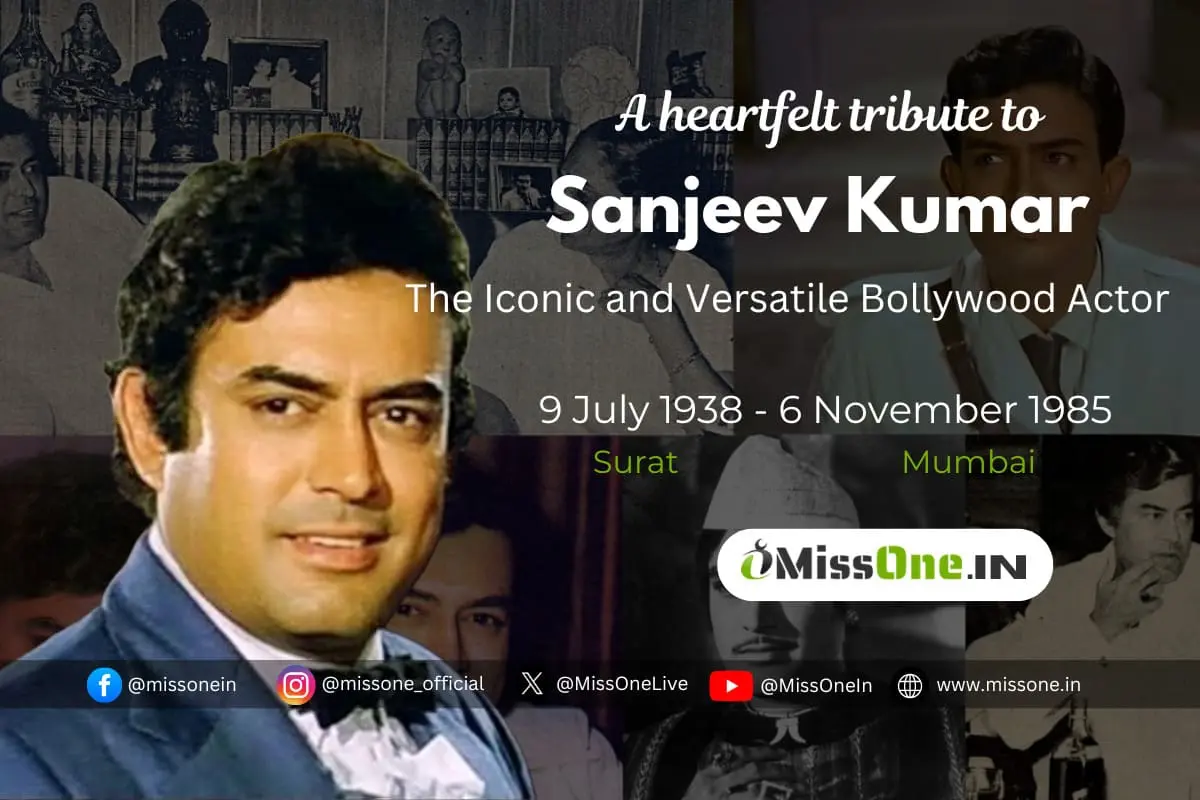
Remembering the Legend on Sanjeev Kumar Death Anniversary
Every year, as the film fraternity and fans observe the Sanjeev Kumar death anniversary, hearts fill with nostalgia and respect. Sanjeev Kumar was not just a film star, he was an actor of rare depth, someone who could turn any role into reality. His expressive eyes, calm voice, and natural style made him one of the most respected performers in Indian cinema. Even decades after his passing, his films continue to inspire actors and entertain audiences across generations.
Born as Haribhai Jariwala, Sanjeev Kumar rose from humble beginnings to become one of the most versatile actors in Bollywood history. His story is one of passion, patience, and an unbreakable love for acting, a journey that still feels alive, especially when we remember him during the Sanjeev Kumar death anniversary.
Early Life and Childhood
Sanjeev Kumar was born on 9 July 1938 in Surat, Gujarat, into a middle-class Gujarati family. His real name was Haribhai Jethalal Jariwala. The family later moved to Mumbai, where young Haribhai began to dream about movies and stage performances.
Unlike many who dreamed of instant fame, he was drawn more to the art of acting than stardom. From a young age, he was fascinated by theatre and storytelling. He would often participate in local stage plays, showing a natural command of emotion and dialogue that amazed those around him.
When his family shifted to Mumbai’s Dadar area, his world began to change. The city’s energy and cinema culture opened new doors. He joined an acting school to polish his talent. The passion for performance soon became his identity.
The Journey into Theatre: Sanjeev Kumar Death Anniversary
Before films, Sanjeev Kumar was a respected stage actor. He joined the famous Indian National Theatre (INT), where he learned the nuances of performance, expressions, and dialogue delivery. His stage name, Sanjeev Kumar, was born here, a name that would soon become legendary.
He performed in numerous Gujarati and Hindi plays, mastering both comic and tragic roles. His theatre experience gave him unmatched depth, which later reflected in his film performances. It was this foundation that set him apart from many of his contemporaries who relied on glamour rather than skill.
Even today, critics and acting students remember him as one of the finest products of Indian theatre.
Film Debut and Early Struggles
Sanjeev Kumar’s first major film was “Hum Hindustani” (1960), where he had a small role. It wasn’t an immediate breakthrough. For years, he struggled, taking on minor roles and waiting for the right opportunity.
His real recognition came in “Nishan” (1965) and “Aao Pyar Karen” (1964). Audiences started noticing his calm yet powerful screen presence. But the turning point came in 1968, when he starred in the film “Shikar”, earning his first Filmfare nomination for Best Supporting Actor.
He didn’t fit the typical hero mold of the 1960s, he wasn’t tall or conventionally handsome, but his authenticity made him stand out. That honesty of character became his trademark.
Rise to Stardom: The 1970s Era
The 1970s were Sanjeev Kumar’s golden years. In this decade, he delivered performances that defined Indian cinema. Movies like “Khilona” (1970), “Dastak” (1970), and “Anubhav” (1971) proved his acting brilliance.
In “Khilona”, he played a mentally challenged man with such realism that critics called it a masterclass in acting. For “Dastak”, he won his first National Film Award for Best Actor.
Soon after, came “Koshish” (1972), where he portrayed a deaf and mute man opposite Jaya Bhaduri. It was a heart-touching film about human resilience, and his performance remains one of the most powerful in Indian cinema.
These films cemented his reputation as an actor who could play any role young or old, rich or poor, hero or villain with equal sincerity.
It’s no surprise that during every Sanjeev Kumar death anniversary, film lovers revisit these timeless classics to celebrate his unmatched craft.
Sanjeev Kumar and Sholay: The Role of Thakur
No discussion of Sanjeev Kumar’s career is complete without mentioning “Sholay” (1975). As Thakur Baldev Singh, a retired police officer seeking revenge, Sanjeev Kumar delivered one of the most iconic performances in Indian cinema.
His portrayal of the handicapped Thakur stoic yet burning with pain became legendary. The intense dialogue delivery, particularly the scene where he confronts Gabbar Singh, is still remembered as one of the most emotional moments in film history.
Interestingly, he was much younger than his co-stars Amitabh Bachchan and Dharmendra, yet convincingly played an older man with authority. This speaks volumes about his acting maturity.
Every Sanjeev Kumar death anniversary brings this role back into the spotlight, reminding fans of his unmatched versatility.
Unconventional Choices and Diverse Roles
Sanjeev Kumar’s genius lay in his ability to choose roles that others avoided. While most actors chased glamour, he was drawn to realism and emotional complexity.
In “Aandhi” (1975), he played a mature, conflicted husband opposite Suchitra Sen. The film was subtle, emotional, and way ahead of its time. His performance was sensitive and layered, winning him another Filmfare Award for Best Actor.
In “Trishul”, “Pati Patni Aur Woh”, and “Angoor”, he showed his comedic timing with effortless charm. Especially in “Angoor” (1982), a double-role comedy based on Shakespeare’s The Comedy of Errors, Sanjeev Kumar proved that even serious actors can master humor.
From romantic leads to aged fathers, from kings to common men, he could play anyone. This range is why, even after his untimely death, critics call him the actor of all seasons.
Awards and Achievements: Sanjeev Kumar Death Anniversary
Sanjeev Kumar’s career was decorated with awards and honors. Some of his notable achievements include:
- National Film Award for Best Actor – Dastak (1970) and Koshish (1972)
- Filmfare Awards – Multiple wins and nominations across decades
- Padma Shri (Posthumous) – Recognition of his contribution to Indian cinema
But beyond the trophies, his real achievement was how deeply he connected with audiences. His characters were relatable, his emotions believable, and his dialogue delivery unforgettable.
During the Sanjeev Kumar death anniversary, these achievements often become the center of film retrospectives and documentaries celebrating his life.
Family and Personal Life: Sanjeev Kumar Death Anniversary
Behind the camera, Sanjeev Kumar was a private person. He came from a simple Gujarati family, deeply connected to his mother and siblings. Despite his fame, he remained humble, often spending evenings with close friends or reading scripts at home.
His family always supported his acting journey. However, he remained unmarried throughout his life.
Sanjeev Kumar’s Marriage and Love Life
Though he never married, Sanjeev Kumar’s personal life was marked by deep emotions. He was known to have been in love with actress Hema Malini, but fate had other plans. When Hema Malini married Dharmendra, Sanjeev Kumar chose to stay single for the rest of his life.
His decision reflected his emotional depth and loyalty. Friends say he was a romantic at heart, yet too sensitive for the glamorous film world.
This aspect of his life often resurfaces during the Sanjeev Kumar death anniversary discussions, where fans remember not just the actor, but the man behind the fame.
Health Issues and Untimely Death
Sanjeev Kumar’s life was tragically short. He suffered from heart problems in his early 40s, and despite medical treatment, his health kept deteriorating.
On 6 November 1985, Sanjeev Kumar passed away at just 47 years old due to a massive heart attack. His sudden death shocked the entire film industry.
Many of his films were released posthumously, including “Professor Ki Padosan”, “Patthar Dil”, and “Qatl”, which continued to keep his memory alive.
Each year, when fans observe the Sanjeev Kumar death anniversary, they remember this great loss to Indian cinema, a talent that left too soon but never faded away.
Legacy and Influence on Indian Cinema
Even decades after his death, Sanjeev Kumar’s influence on acting remains profound. He inspired generations of performers who admire his subtle expressions, emotional control, and commitment to realism.
Actors like Naseeruddin Shah, Irrfan Khan, and Manoj Bajpayee have often mentioned that Sanjeev Kumar paved the way for character-driven cinema in India.
The Sanjeev Kumar Foundation in Surat continues his legacy by supporting theatre and film talent. Every Sanjeev Kumar death anniversary sees film clubs, theatres, and television channels revisiting his classic movies to honor his artistry.
His versatility, from “Sholay” to “Angoor,” from “Aandhi” to “Koshish” continues to remind people that true acting lies in truth, not glamour.
Hit Films of Sanjeev Kumar
Sanjeev Kumar’s filmography is vast, but some films stand out as all-time classics:
- Sholay (1975)
- Aandhi (1975)
- Koshish (1972)
- Angoor (1982)
- Trishul (1978)
- Pati Patni Aur Woh (1978)
- Mausam (1975)
- Dastak (1970)
- Khilona (1970)
- Manchali (1973)
Each film reflects a different facet of his immense talent. From drama to comedy, tragedy to suspense, he did it all with equal brilliance.
Memorable Songs from Sanjeev Kumar’s Films
Music played an important role in his movies. His expressions often enhanced the emotional depth of songs like:
- “Tum Aa Gaye Ho Noor Aa Gaya” (Aandhi)
- “Meri Bheegi Bheegi Si” (Anamika)
- “Thande Thande Paani Se” (Pati Patni Aur Woh)
- “Raina Beeti Jaye” (Amar Prem)
Even though he wasn’t a singer, his on-screen presence added soul to every melody. During the Sanjeev Kumar death anniversary, radio stations often play these songs as a tribute to the legend.
Lesser-known Facts: Sanjeev Kumar Death Anniversary
- He auditioned for the role of Arjun in the film Humraaz, but was rejected for being “too serious.”
- Sanjeev Kumar was one of the few actors to play roles older than his actual age multiple times.
- He was offered roles opposite nearly every top heroine of his time, Hema Malini, Jaya Bhaduri, Sharmila Tagore, and Tanuja.
- He loved Gujarati food and was known for his simple lifestyle despite stardom.
- Many film critics believe if he had lived longer, he would have been India’s answer to Dilip Kumar in depth and Amitabh Bachchan in popularity.
These insights make him even more human, reminding us why the Sanjeev Kumar death anniversary still carries emotional weight among fans.
Sanjeev Kumar’s Acting Style: Natural and Timeless
Sanjeev Kumar never overacted. His secret was subtlety. He believed acting wasn’t about loudness but truth. Whether it was a simple smile, a tear, or a quiet stare, he could convey what others needed pages of dialogue for.
He once said in an interview, “If the audience forgets they are watching an actor, then I have done my job.”
That’s what made his roles timeless. On every Sanjeev Kumar death anniversary, film schools analyze his craft, calling him “the thinking man’s actor.”
Conclusion: Sanjeev Kumar Death Anniversary
As we commemorate another Sanjeev Kumar death anniversary, one thing remains clear legends never truly die. His performances still breathe life into the silver screen. He wasn’t just an actor; he was an emotion, a reminder that sincerity can outshine glamour.
Sanjeev Kumar lived a short but meaningful life, one filled with dedication, artistry, and love for cinema. His story continues to inspire actors, directors, and audiences alike.
Even today, when we watch Sholay or Aandhi, it feels like he’s still here, living within those unforgettable characters.
So this year, as we remember the Sanjeev Kumar death anniversary, let us not mourn his passing but celebrate his eternal presence in Indian cinema, through every role, every dialogue, and every emotion he ever brought to life.