
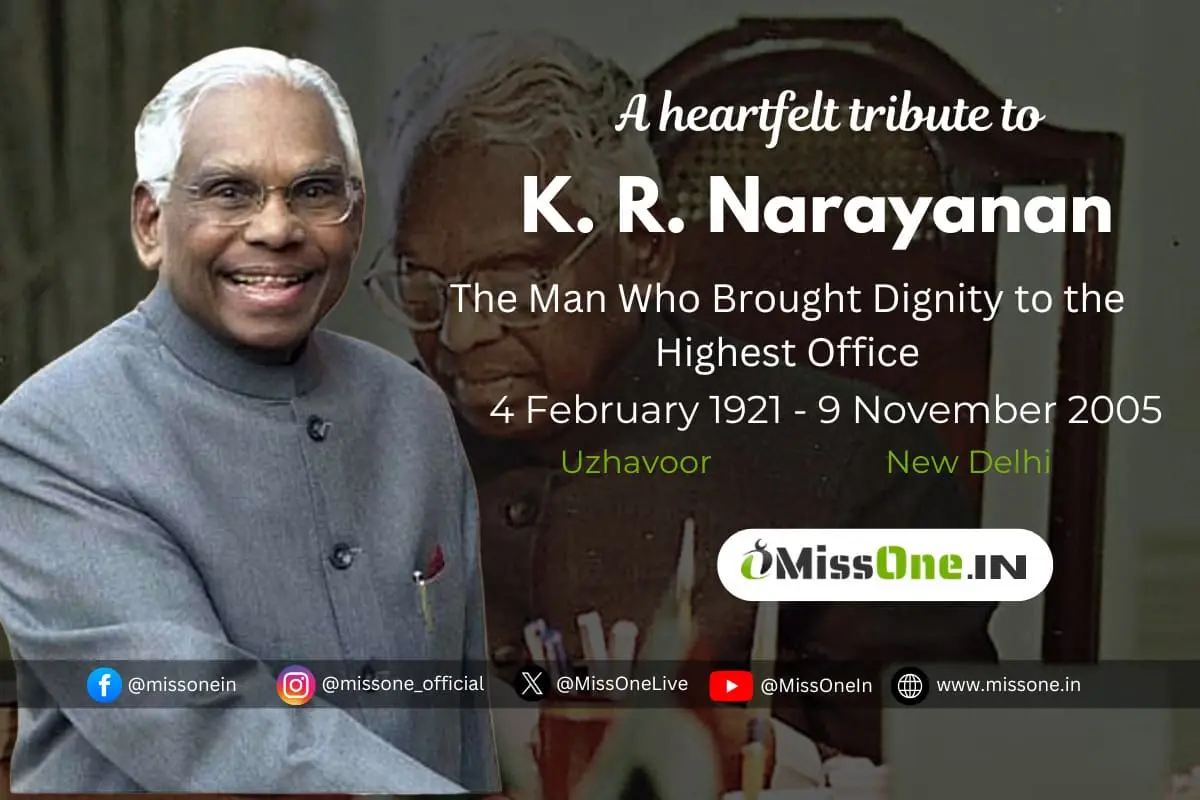
Today, as we mark the death anniversary of K. R. Narayanan, we reflect on a life that traversed enormous challenges and remarkable heights. Born into a modest family, he rose to become the 10th President of India and the first from the Dalit community to hold that office. In this post, we’ll walk through K. R. Narayanan’s childhood, his marriage, the twists and turns of his life history, his career, honours and awards, lesser-known facts and the legacy he left behind. The phrase K. R. Narayanan death anniversary appears here for reflection, a moment to remember his service, his dignity, and his unwavering commitment to justice and equality.
Childhood and Early Years
K. R. Narayanan was born on 27 October 1920 (though some records cite 4 February 1921) in the village of Uzhavoor, in the erstwhile Travancore Kingdom, now in Kerala.
His family belonged to the Paravan caste (traditionally regarded as “untouchables”), and they lived in very modest circumstances.
Walking many kilometres to school, overcoming social prejudice, and striving to excel in studies these formed the foundation of his character. Even in school days, his talent was visible.
He completed his B.A. (Honours) and M.A. in English Literature from the University of Travancore (now the University of Kerala) and was among the very first Dalits to secure first-class honours there.
In short, the early years of K. R. Narayanan’s life were marked by hardship, grit and ambition. As we remember his death anniversary, we also remember the child from Uzhavoor who dared to dream.
Marriage and Family Life
In the course of his foreign service posting in Rangoon (now Yangon), Burma, K. R. Narayanan met Ma Tint Tint, a Burmese-born woman who later took the name Usha Narayanan.
They got married in 1951 in Delhi, with special permission because Narayanan was an IFS officer and his bride a foreign national.
The couple had two daughters, Chitra and Amrita. Usha Narayanan was a supportive partner through his diplomatic, academic and political journey. Their family life remained quietly dignified even as K. R. Narayanan rose to national prominence.
On the K. R. Narayanan death anniversary, it is worth pausing to remember not just the public figure, but the husband and father who carried both public responsibility and private devotion.
Life Story & Career Path
From Journalist to Diplomat
After his master’s degree, K. R. Narayanan worked as a journalist for The Hindu (1944–45) and The Times of India (1945).
Then, awarded the Tata Scholarship, he studied at the London School of Economics under the great political scientist Harold Laski, before returning to India in 1948.
In 1949, he joined the Indian Foreign Service (IFS). Starting as an attaché, he served in Rangoon, Tokyo, London, Canberra and Hanoi – and later as Ambassador to Thailand, Turkey and China.
Prime Minister Jawaharlal Nehru once described him as “the best diplomat of the country.”
These years as diplomat helped shape his worldview global, values-oriented, rooted in social justice.
Academic & Administrative Roles
In 1979, after retirement from the foreign service, he served as Vice-Chancellor of Jawaharlal Nehru University (JNU), an academic role he called the foundation for his later public life.
Later, he was recalled to serve as Ambassador to the United States (1980-84), a period of challenging international relations.
Political Career
In 1984, K. R. Narayanan entered politics on the invitation of Prime Minister Indira Gandhi and was elected to the Lok Sabha from Ottapalam in Kerala.
He held ministerial roles for Planning, External Affairs and Science & Technology.
Vice-President & Presidency
In 1992, K. R. Narayanan became the Vice-President of India.
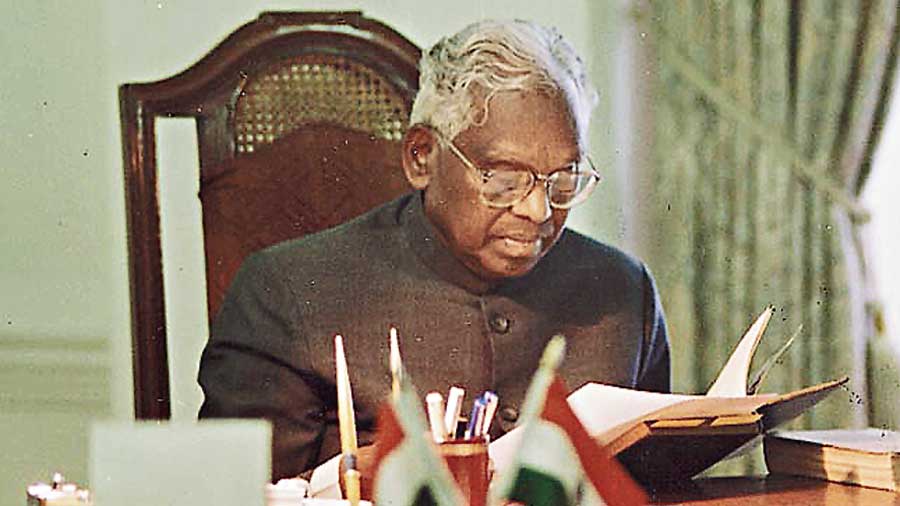
Then in 1997 he was elected President of India, serving until 2002 – the first Dalit and the only Malayali so far to hold the role.
As President, he took a more proactive role than many before him, emphasising the Constitution, the rights of the disadvantaged, and inclusive growth.
Throughout his life, culminating during his presidency, the term K. R. Narayanan death anniversary serves not just as a date but as a marker of reflection on service, dignity and the power of democracy.
Achievements, Awards & Masterstrokes
- His story is powerful: from an under-privileged background to India’s highest constitutional office.
- He helped redefine the role of President to one that upheld socio-economic justice and constitutional propriety.
- Institutions bear his name, e.g., the K. R. Narayanan National Institute of Visual Science and Arts in Kottayam, Kerala.
- His presidency coincided with India’s 50 years of Republic, and his speeches emphasised democratic inclusion.
While he may not have a long list of popular “awards” like entertainers do, his real award was the trust of the people and his steady, moral leadership. And every year on the K. R. Narayanan death anniversary, we honour that.
Lesser-Known Facts
- During his university days in London, he studied with Harold Laski and returned with a letter of introduction to Nehru – which helped him enter the IFS.
- He was the first sitting President in India to cast his vote in a general election (1998).
- He came from a community long denied social privileges, yet rose in the civil, diplomatic and political valley of India: a living testament to democracy.
- On his K. R. Narayanan death anniversary, one remembers that his life was less about pomp, and more about principle.
Legacy & Why We Remember Him on the Death Anniversary
On occasions like the K. R. Narayanan death anniversary, we don’t just remember dates, we remember values: equality, scholarship, constitutionalism, humility.
He showed that the highest office of the land could be held with sensitivity to the weak, respect for all communities, and an unshakeable commitment to the rule of law. His journey tells countless young Indians: where you start does not determine where you can go.
He also expanded what it means to hold high office, to speak strongly for the marginalised, and to serve beyond ceremony. Even now, educational institutions, memorials, scholarly works recall his impact.
Final Thoughts
As we mark the K. R. Narayanan death anniversary, let us take a moment to internalise the lessons his life offers:
- Humility is compatible with greatness.
- Social origin need not limit ambition.
- Service to country can be quiet, persistent, principled.
- Democracy does not only belong to the powerful, it belongs to those who persist, speak truth and remain committed.
K. R. Narayanan may no longer be among us, but his spirit remains alive in institutions, in the idea of equal opportunity, in the notion that a child from a small village in Kerala can one day sit in Rashtrapati Bhavan. And that is a story worth telling especially on his death anniversary.
In remembrance of K. R. Narayanan, his life is both history and inspiration. On his death anniversary, let us honour his memory by reflecting on the path he trod, the changes he championed, and the ideals he lived by.