
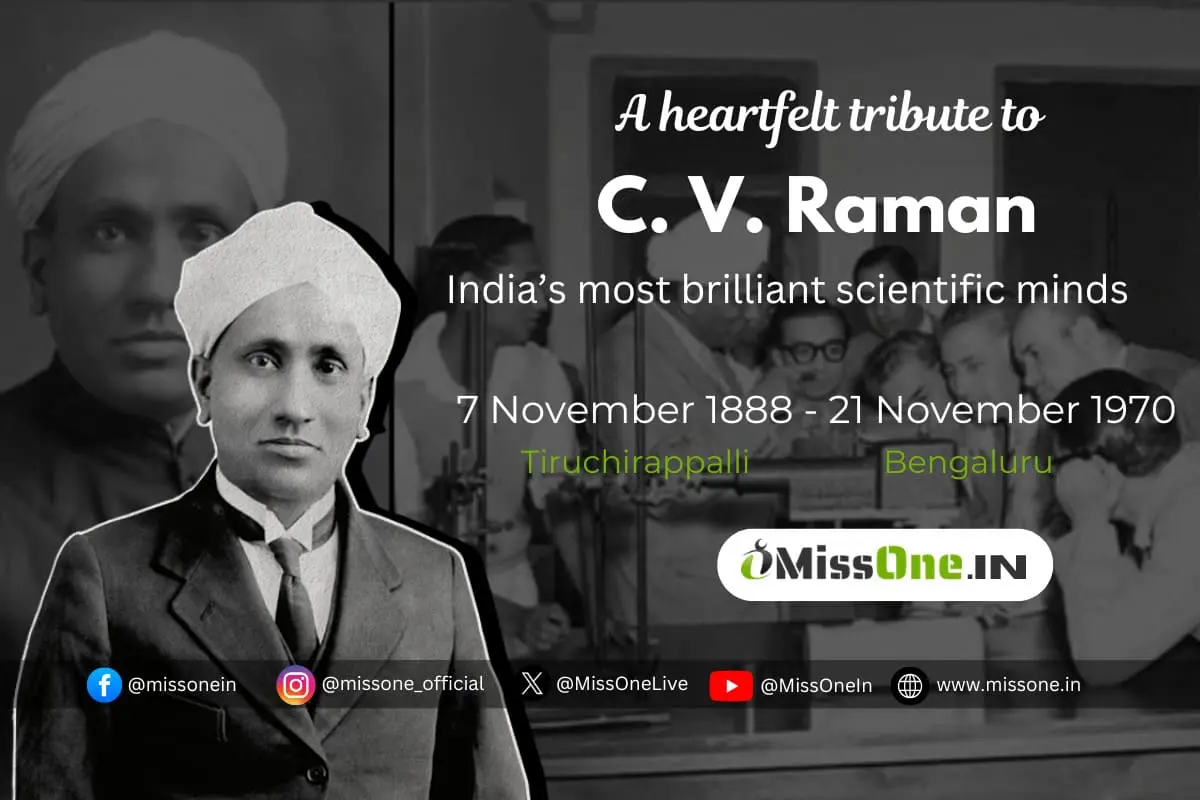
Remembering the Legend on C. V. Raman Death Anniversary
Sir Chandrasekhara Venkata Raman remains one of India’s most brilliant scientific minds. Every year, as we observe C. V. Raman death anniversary, people across India and the world remember the man who changed the way we understand light. His discovery known today as the Raman Effect opened a new chapter in physics and earned him a Nobel Prize. Yet, his story is not only about awards; it is also about curiosity, courage, and a lifelong love for science.
This biography takes you through C. V. Raman’s childhood, education, family life, career, achievements, Raman Effect, and the important milestones that shaped him. Along the way, we also mark C. V. Raman birth anniversary, share little-known facts, and present a heartfelt tribute to C. V. Raman, especially as we reflect on the meaning of C. V. Raman death anniversary in India’s scientific history.
C. V. Raman’s Childhood – A Young Mind Full of Wonder
C. V. Raman was born on 7 November 1888 in Tiruchirappalli, Tamil Nadu. Today, this date is celebrated as C. V. Raman birth anniversary. He grew up in a simple home filled with books, music, and learning. His father, Chandrasekhara Iyer, was a teacher of mathematics and physics. Because of this, Raman grew up surrounded by scientific ideas even before he entered school.
From a very young age, Raman showed unusual curiosity. He would ask questions not many children thought about:
Why does the sky look blue? Why does sound travel the way it does? Why do some materials shine differently in the sunlight?
These questions stayed with him throughout his life.
A Home that Encouraged Learning
Unlike many families of that time, the C. V. Raman family placed great importance on education. Books were easily available, and discussions about science were common. This environment shaped Raman’s sharp thinking and set the foundation for his legendary discoveries.
Even as a child, he was gifted at studies. He topped every exam and often amazed his teachers with both intelligence and discipline. He completed his schooling at a very early age and joined college when most children his age were still in school.
Early Education – The Making of a Scientist
Raman studied at Presidency College, Madras, where he quickly made a name for himself. He won prizes, gold medals, and scholarships. But what truly set him apart was his deep interest in conducting small experiments.
While other students studied textbooks, Raman would open instruments, study their design, and analyze how things worked. His professors often said he was “born to be a physicist.”
At just 16, Raman graduated with a B.A. in Physics, placing first in the university. Two years later, he completed his M.A. in Physics with record-breaking marks.
Yet, life had a surprise waiting for him.
A Civil Service Job – But Science Was His Real Calling
Although he loved science, Raman decided to appear for the Indian Finance Service (IFS) exam, a prestigious government job under British rule. Surprisingly, he not only passed but also secured the first rank.
He moved to Calcutta (Kolkata) to begin his government career. This job gave him financial security, which was important for the middle-class C. V. Raman family. But Raman’s heart remained in science.
Every day after office hours, he would go to the Indian Association for the Cultivation of Science (IACS). There, he worked late into the night, performing experiments and studying topics that fascinated him. This dual life government officer by day, scientist by night continued for almost ten years.
Turning Point – Leaving Civil Service for Science
Raman’s work at IACS soon gained attention. His published research papers on acoustics and vibrations were admired internationally. Many scientists wondered how a government officer could produce such brilliant scientific work.
In 1917, Calcutta University offered him the prestigious Palit Chair of Physics. For Raman, this was a dream. Without hesitation, he resigned from the civil service even though it was considered a risky decision. But Raman believed the path of science was worth any sacrifice.
This moment changed Indian science forever.
Marriage and Family Life – Support Behind the Success
Raman married Lokasundari Ammal in 1907. She was intelligent, supportive, and strong-willed. She not only cared for the household but also encouraged Raman in his scientific work. It is said that she often accompanied him to conferences and helped maintain balance in his extremely busy life.
The C. V. Raman family included two sons:
- Chandrasekhar Raman
- Radhakrishnan Raman
Though Raman was deeply focused on his scientific research, he always believed in discipline, values, and education at home.
The Raman Effect – The Discovery that Shook the World
Now we arrive at the turning point in Raman’s scientific journey: The Raman Effect.
The Famous Ship Journey
In 1921, Raman traveled to Europe to attend the British Empire Universities Congress. On his ship journey back to India, he kept observing the sea and sky. He carried scientific instruments with him even on vacation!
One day, while studying the reflection of sunlight on the sea, he started thinking about how light behaves when it enters water or transparent materials. This curiosity led him to years of research.
The Breakthrough
On 28 February 1928, Raman finally discovered that when light passes through a transparent material, it changes its wavelength and scatters differently. This effect is now called the Raman Effect.
It was such an important event that today, 28 February is celebrated as National Science Day in India.
Global Recognition
In 1930, Raman became the first Indian and first Asian to win the Nobel Prize in Physics for the Raman Effect.
This achievement remains one of the greatest scientific milestones in Indian history.
C. V. Raman’s Career – A Life Dedicated to Science
Throughout his life, Raman worked in many important positions:
1. Professor at Calcutta University (1917–1933)
He inspired students, conducted breakthrough research, and built laboratories.
2. Director of Indian Institute of Science (IISc), Bangalore (1933–1948)
He became the first Indian director of IISc. His leadership transformed the institute.
3. Founder of Raman Research Institute (RRI) (1948)
After retiring from IISc, he established his own institute in Bangalore. Even at an old age, he conducted experiments every day.
4. Mentor and Guide
He trained hundreds of scientists who later contributed greatly to Indian science.
Awards and Achievements – Honors That Celebrate a Genius
C. V. Raman received countless awards. Some notable ones include:
- Nobel Prize in Physics (1930)
- Fellow of the Royal Society (FRS)
- Bharat Ratna (1954) – India’s highest civilian award
- Lenin Peace Prize
- Franklin Medal
- Matteucci Medal
But beyond awards, his biggest achievement was inspiring generations of Indians to believe that world-class science can be done in India.
Lesser-Known Facts About C. V. Raman
Here are some surprising facts that shine light on his personality:
- Raman loved music and studied the physics of musical instruments.
- He conducted many experiments using extremely simple tools.
- He disliked unnecessary formalities and preferred a direct, simple lifestyle.
- He often said, “Ask the right question, and nature will always answer.”
- He once refused to attend an event where scientists were not given freedom of speech.
- He worked in his laboratory even one day before his death.
- He believed Indian students could surpass global scientists if given the right environment.
These facts are often shared during events that mark C. V. Raman death anniversary, reminding us of the man behind the achievements.
C. V. Raman Death Date – The Final Chapter of a Glorious Journey
C. V. Raman passed away on 21 November 1970 at the age of 82. This date is known as C. V. Raman death date and is observed across India as a moment of remembrance.
Even in his final days, he refused to spend time in the hospital. Instead, he chose to stay at the Raman Research Institute surrounded by the science he loved. It is said that just two days before his passing, he spoke passionately about the importance of curiosity and scientific thinking.
Today, C. V. Raman death anniversary reminds us of the legacy of a man who gave India global recognition in science.
Why C. V. Raman Death Anniversary Holds Great Importance
The observance of C. V. Raman death anniversary is more than a ritual. It is a reminder of:
- The power of curiosity
- The importance of scientific research
- India’s ability to produce world-class scientists
- The value of dedication and discipline
Schools, colleges, and research institutes conduct special programs every year to honor his work. Many scientists also consider C. V. Raman death anniversary as a day to reflect on India’s scientific progress.
Tribute to C. V. Raman – A Legend Who Lit the Path of Science
A true tribute to C. V. Raman must go beyond praising him. It must inspire future generations to think boldly and question deeply.
We remember him as:
- A scientist who challenged British-era limitations
- A teacher who awakened young minds
- A visionary who believed India could lead the world in science
- A man who never stopped exploring
His journey from a small Indian town to the Nobel Prize stage remains a story that still motivates millions, especially when we observe C. V. Raman birth anniversary and C. V. Raman death anniversary.
Legacy – Light That Continues to Shine
More than fifty years after his passing, Raman’s legacy lives on through:
- Raman spectroscopy, used in chemistry, medicine, space science, and material science
- Research institutions that still follow his methods
- National Science Day celebrations
- Textbooks and workshops
- The inspiration he gives to students worldwide
His work continues to guide modern inventions, proving that his contribution was not limited to his era but extends far into the future.
C. V. Raman Death Anniversary – Reflections on His Lifelong Journey
As we mark C. V. Raman death anniversary, we reflect on:
- His courage to leave government service
- His unstoppable love for science
- His global recognition
- His commitment to Indian research
- His inspiring teaching style
From C. V. Raman family to millions of students, his story touches hearts everywhere.
Conclusion – The Scientist Who Taught Us to See Light Differently
Sir C. V. Raman’s life is a story of passion, bravery, and unwavering dedication. His childhood curiosity turned into global discovery. His love for science shaped India’s research journey. His awards brought pride to the nation. And his passing marked through C. V. Raman death anniversary reminds us of the rare brilliance India produced.
Through every tribute to C. V. Raman, every mention of C. V. Raman birth anniversary, and every remembrance on C. V. Raman death anniversary, we celebrate more than a scientist, we celebrate a guiding light whose glow will never fade.